A Practical Video Verification Workflow for Journalists, Moderators, and Trust & Safety Teams
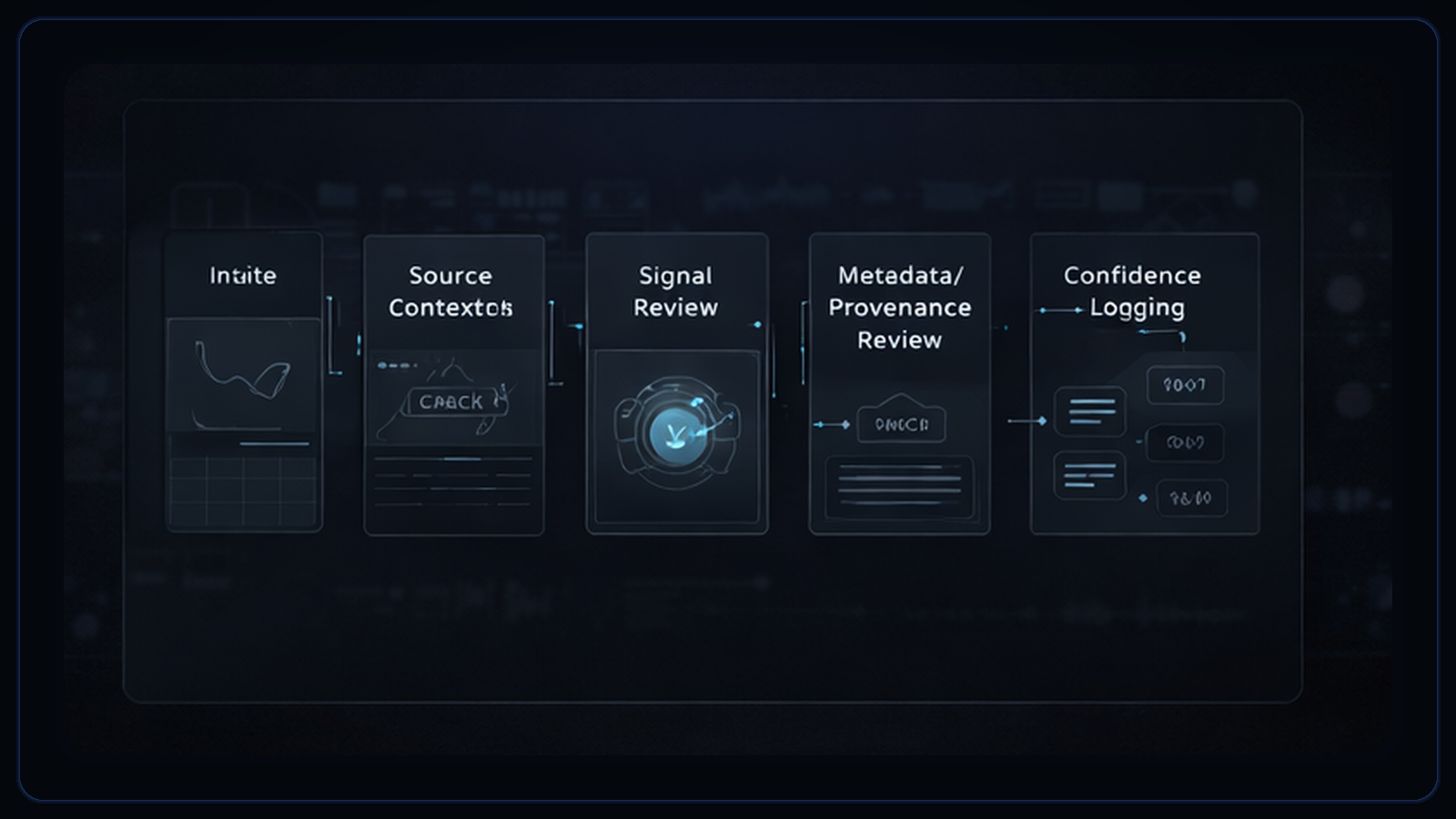
A defensible workflow preserves the file, separates review stages, records missing evidence, and defines when to escalate instead of guessing.
- 01
Preserve the best available file before you start making claims from reposts.
- 02
Separate source checks, signal review, provenance review, and escalation instead of blending them together.
- 03
Record what was missing or degraded, not just what looked suspicious.
- 04
High-stakes cases should route to human review before anyone forces certainty.
The hardest part of verification is usually not the first question. It is the discipline that follows: what gets preserved, what gets checked first, and when a team decides the file is not strong enough for a confident call.
This workflow is for teams that cannot afford casual habits. It works for newsroom intake, moderation queues, trust-and-safety escalations, and internal investigations where a clip may influence a consequential decision.
Who this workflow is for
The common problem is not only “is this fake?” It is “what can we responsibly say, and what happens next?”
Journalists need this when a clip may enter publication. Moderators and trust and safety teams need it when a suspicious upload could drive enforcement. Researchers and investigators need it when both evidence and uncertainty must survive review.
Step 1: Intake and preservation
Your first win is often boring but essential: do not let the worst repost become the only copy anyone ever reviews.
Start by preserving the highest-quality version you can obtain. If the original file, direct export, or closest-to-original upload can still be requested, do that before deeper review.
- 01Save the working copy
Record filename, source URL, acquisition timestamp, and any visible platform context before additional handling.
- 02Log chain-of-custody basics
Note who supplied the clip, when it was received, and whether it came through messaging, email, cloud storage, or a public post.
- 03Preserve claims separately from facts
Source statements about location, time, and authorship should be logged, but not treated as verified simply because they accompany the file.
Step 2: Source, context, and signal review
Before a team gets lost in forensic details, it should ask what should be true if the clip is genuine and then review the signal categories separately.
A useful workflow asks two questions early: what should be true if the clip is real, and what does the media itself show? Those are related, but they are not the same.
- Source and context: Check who supplied the clip, when it was received, what it claims to show, and whether the source has a plausible path to the footage.
- Media signals: Review visual detail, motion continuity, face and lip-sync behavior, audio, metadata, and provenance as separate evidence streams.
- Visible gaps: Unavailable modules should stay visible to the reviewer instead of collapsing into a false sense of completeness.
Step 3: Provenance, corroboration, and confidence
File review is only part of the call. Teams still need to know what origin evidence exists and how much uncertainty should remain in the written conclusion.
Metadata and provenance answer different questions from pixel review. They explain packaging history, export paths, content credentials, and whether any trustworthy origin evidence survives with the file.
Teams should explicitly note when provenance is absent, when corroboration is weak, and when the conclusion is limited by evidence quality rather than tool quality. Our guide to content credentials and C2PA goes deeper on how provenance fits into the stack.
Step 4: Escalation paths and hold decisions
A workflow is not complete until it defines what happens when the file is weak, the stakes are high, or the signals conflict.
- Escalate when stakes are high: Potential public harm, reputational damage, legal exposure, or fast-moving news all justify a higher review bar.
- Escalate when provenance is weak: If the clip cannot be tied back to a source or trustworthy acquisition path, human review should stay in the loop.
- Escalate when the signals conflict: A strong pixel-level concern paired with strong source corroboration is exactly the kind of case that needs careful human judgment.
Holding a clip is not failure. If the file is degraded, provenance is weak, and the consequence of a wrong call is high, delaying publication or continuing review is often the best decision available.
Sources and standards
Use DetectVideo as an initial review layer
DetectVideo is most useful at intake: it helps teams structure the first pass, separate available signals from missing evidence, and decide what needs escalation instead of turning every clip into a full forensic case.
Related articles
A useful review looks for clusters of evidence, not one weird frame. The best signals show up across visuals, motion, sync, metadata, and provenance.
Detection is hard because the clips people care about most are often short, degraded, reposted, or missing evidence modules entirely.
Content credentials are provenance metadata, not magic labels. They can strengthen origin claims when present, but they do not replace forensic review.
About this article
Written by DetectVideo Editorial Team.
Technical review by DetectVideo Methodology Review.
Last updated April 12, 2026. Related articles are included for readers who want adjacent context, terminology, and workflow guidance.